
Download Data Centers Info Sheet
Data Center Development in Cedar Rapids
This page is intended to serve as a central resource for residents, businesses, policymakers, and community partners to better understand current data center projects in Cedar Rapids, how those projects were evaluated, the City’s role in project review, what public benefits are included, what infrastructure planning is underway, and how the City approaches potential future large-scale development.
The City of Cedar Rapids is committed to being as transparent, clear, and comprehensive as possible when sharing public information about data center development and related economic development agreements, water and utility planning, public incentives, and long-term infrastructure decisions.
Our goal is to make relevant public information easy to find and easy to understand. As with all public information, the City shares records and project details consistent with Iowa open records law, applicable legal requirements, and the responsible handling of information that is not yet public or is otherwise protected from disclosure. If you have any questions or are looking for information that is not yet on this page, please contact communications@cedar-rapids.org.
Because many public questions focus on water, this page includes detailed information about current treatment capacity, source water, long-term planning, and ratepayer protections.
Fast Answers to Common Questions
- Cedar Rapids has approved development terms or agreements for two data center projects: Google and QTS.
- Another data center, at 1515 33rd Avenue SW, is being built without City incentives on a property already zoned for industrial use. Rather than receiving a development agreement, it moved through the City’s standard development review and permitting process.
- Current water treatment capacity is sufficient for current and near-term planned growth, including approved data centers.
- The City has not made an open-ended commitment to serve every future data center or regional project.
- Incentives apply to new value created by the project and are earned only if agreement terms are met.
- How the public hears about development projects depends on the City action required: projects needing Council approval or a public hearing are shared through those public processes, while projects already allowed under existing zoning proceed through standard permitting.
Find Information on This Page
Use the sections below to jump directly to the topic you are looking for:
Overview
Project Specifics
- Google Data Center Campus
- QTS Data Center Campus
- Data Center Projects Without City Development Agreements
Key Public Questions
- Water
- Energy
- Evaluating Future Projects
- What the City Is (and Is Not) Committed To
- Other Frequently Asked Questions
Overview
Why Data Center Projects Matter
Data centers are one type of industrial development that supports digital services used by businesses, government agencies, health care providers, schools, and residents.
The City considers economic development incentives for projects proposed within the context of its broader economic development strategy, which includes targeted development in the technology, professional services, and advanced manufacturing sectors with a goal of attracting higher-wage and higher-skill, white-collar employment opportunities.
Cedar Rapids’ economy already depends on information, technology, professional services, and advanced industry. The region includes approximately 9,100 area college students, 2,500 technology workers, and 17,300 professional-services workers. The City evaluates data center proposals as part of its broader economic development strategy, which includes technology, professional services, advanced manufacturing, and other target industries. While data centers are not only about artificial intelligence, AI and other advanced digital technologies are expected to have a significant effect on the global economy and increasingly viewed as essential infrastructure supporting the long-term economic competitiveness of regions. They may also create new types of occupations in communities positioned to support technology-driven growth.
At the same time, Cedar Rapids recognizes that growth brings questions. Residents deserve clear answers about water use, taxes, incentives, infrastructure, environmental stewardship, ratepayer protection, and long-term planning.
The City of Cedar Rapids supports investment when it can be evaluated responsibly, structured transparently, and managed in a way that protects residents, existing industries, public services, natural resources, and long-term system reliability.
Current Projects & Future Planning
The City’s role is not the same for every data center project. The process depends on whether the proposed use is allowed under existing zoning and whether the developer requests incentives, infrastructure assistance, land-use changes, or another form of discretionary City action.
Projects with City Development Agreements
The most detailed project information on this page relates to two large data center campuses for which the City approved development agreement terms or agreements:
- The Google Data Center Campus
- The QTS Data Center Campus
These are the projects for which the City has approved development agreement terms or agreements and compiled detailed information about incentives, commitments, timelines, and related public records.
At the time of approval, each project represented the largest capital investment in Cedar Rapids history. Together, they demonstrate the City’s ability to coordinate the complex development, infrastructure, utility, and public-service considerations associated with major national and global business opportunities.
Projects Permitted Under Existing Zoning
Other data center projects may be allowed under a property’s existing zoning and may not require a development agreement, rezoning, financial incentive, or other discretionary approval.
That does not mean these projects are exempt from City review. Staff review development applications for compliance with applicable requirements, which may include:
- Zoning and site-development standards
- Building and fire codes
- Stormwater-management requirements
- Engineering and utility coordination
- Site access and transportation considerations
- Landscaping, screening, and other development standards
Additional state, county, or federal requirements may apply depending on a facility’s equipment and operations.
A Consistent Approach to Responsible Growth
Data center and large industrial development is a fast-changing sector. Additional companies may evaluate sites in Cedar Rapids or nearby communities, and future proposals may differ significantly in their size, operations, infrastructure needs, and requested level of City involvement.
The City’s role is to evaluate each potential project carefully, based on facts, infrastructure capacity, legal authority, public benefit, and future impact. Major private investment can add taxable value, generate revenue, support infrastructure improvements, and build capacity that may benefit broader economic and community development. At the same time, those benefits must be considered alongside infrastructure capacity, utility reliability, water resources, public-service demands, legal authority, financial risk, and long-term community impact.
The City has not made open-ended commitments to serve every future project. Any future project requiring City action, City incentives, utility service, infrastructure expansion, land use approvals, or development agreement terms would need to be evaluated through the appropriate public, technical, legal, and policy processes.
Cedar Rapids supports responsible growth. That means welcoming investment while protecting residents, existing industries, public services, water resources, utility reliability, and long-term financial sustainability.
Public Information for Data Center Projects
How the public hears about a project depends on what City action is needed.
Projects that need a public hearing or City Council approval are shared through those public meetings. Meeting agendas, reports, agreements, and other records are posted for the public.
Projects that are already allowed under existing zoning follow the City’s normal review and permit process. They may not need a public hearing or Council vote.
- On February 27, 2024, the City Council approved development agreement terms for the project at a public meeting.
- On March 21, 2024, the City announced that Google was the company behind the project and shared information about the investment, jobs, incentives, utilities, and community funding.
QTS
- On November 19, 2024, the City Council approved plans related to the project area at a public meeting.
- On January 28, 2025, the City Council approved the QTS development agreement at a public meeting.
- On February 12, 2025, the City, Alliant Energy, and QTS announced the project and identified QTS as the company developing the campus.
The Google and QTS projects sought City development agreements and economic development incentives. That is why both projects went through public City Council processes. Information was shared through meeting agendas, public records, City announcements, news coverage, and the City’s website.
1515 33rd Avenue SW
- A building permit was issued on June 22, 2026.
- The property was already zoned for industrial use.
- Data centers are allowed under that zoning.
- The project is privately funded.
- It did not receive City incentives or require a development agreement, rezoning, public hearing, or City Council vote.
The City reviews and permits many private development projects each year. Because of that volume, the City does not normally issue an announcement for every project. Announcements are generally made when there is a public hearing, City Council action, development agreement, financial incentive, City partnership, or other important community information to share.
A project that does not receive an announcement still goes through City review. Staff check projects for compliance with zoning rules, building and fire codes, stormwater requirements, site standards, utility needs, street access, and other applicable requirements. Permit and property records are also available to the public.
Economic Development in Context
Cedar Rapids has spent years planning for community and economic growth. Projects of this scale require available land, infrastructure capacity, workforce availability, market conditions, and coordination among public and private partners. They also require a local government capable of managing complex development processes.
Since 2015, incentive-supported projects in Cedar Rapids have represented nearly $3.8 billion in total capital investment, helped retain more than 4,200 existing jobs, and created more than 2,800 new jobs.
Conservative estimates project approximately 3,000 new construction jobs in Cedar Rapids through 2030 associated with the Google and QTS projects. The economic benefit of construction employment is estimated at $423 million per year in new wages. During the construction phase, each dollar paid to temporary construction workers is estimated to generate an additional $0.47 in the metro economy. Construction activity also has the potential to support up to 5,000 additional jobs through supply-chain activity and increased household spending.
Large-scale projects also send a signal to the market. These types of investments in Cedar Rapids demonstrate our community can compete for major national and global business opportunities and manage complex development at a national scale.
How Development Agreements & Incentives Work
Major economic development projects sometimes require a formal agreement between the City and the company or developer. These agreements define the project commitments, public benefits, timelines, reporting requirements, and any incentive terms approved by the Cedar Rapids City Council.
Incentives are not automatic. A project does not receive City support simply because another project did. Each proposal must be evaluated on its own facts, including its financial feasibility, infrastructure needs, public benefit, long-term tax base impact, and alignment with City goals.
One commonly used economic development tool is Tax Increment Financing, or TIF. TIF allows a portion of the new property tax revenue generated by a project’s increased value to be used for eligible public improvements, infrastructure, or other development-related costs. Existing taxes on the base value of the property continue to be paid. Such incentives are generally tied only to the new value created by the project, or to other eligible revenues specifically defined in the agreement.
Before any incentive is approved, the City evaluates whether the project meets applicable requirements, such as:
- ✓ Financial and market feasibility
- ✓ Experienced development team
- ✓ Quality design and site planning
- ✓ Compliance with zoning, building, utility, and other City requirements
- ✓ Infrastructure readiness and service capacity
- ✓ Minimum capital investment
- ✓ Job creation or retention
- ✓ Wage quality
- ✓ Long-term tax base growth
- ✓ Strategic community value
- ✓ Demonstrated public benefit
- ✓ Whether incentives are necessary to support the project
If approved, the development agreement establishes the specific terms a company must meet. These may include minimum investment, construction timelines, project phases, job or wage commitments, taxable value created, reporting requirements, and compliance with local and state requirements.
Incentives are performance-based, meaning developers must meet required agreement terms before incentives are earned. If a company does not meet the requirements, incentives may be reduced, delayed, withheld, or otherwise affected according to the agreement.
When used carefully, development agreements allow the City to support responsible growth while protecting public interests. After the incentive period ends, the full taxable value of the project remains in the local tax base, subject to applicable law. In the long run, this means the increased property value created by the project becomes part of the community’s ongoing tax base.
Understanding How Incentives & Taxes Relate
A common question is whether the City is “giving away” taxes.
It is important to note that existing taxes on the original property value continue to be paid. Incentives apply only to the new value generated by a project — and only under the terms of the agreement.
The City’s goal is to secure major investment that would not otherwise occur at the same scale, while still generating new tax revenue, jobs, infrastructure investment, and community benefits over time.
Case Study: Google Data Center Project
This example illustrates how development incentives apply to new value created by a project. Taxes on the property’s original assessed value continue to be paid. During the incentive period, the City and other local taxing bodies retain a portion of the new property tax revenue generated by the project, while the remaining portion may qualify for performance-based incentives if agreement terms are met. After the incentive period, the increased taxable value remains part of the local tax base, subject to applicable law.
Assessed Lot Value Before Project: $1 Million ⤦
Initial Project: $576 Million Minimum Investment ⤦
Estimated Assessed Value After Project Completion: $101 Million ⤦
Related Taxes:
- 100 percent of taxes on the property’s initial $1 million valuation continue to be paid. These taxes continue to fund public services like Police, Fire, Schools, etc.
- City receives 30 percent of any new taxes generated by the project’s new valuation. The remaining 70 percent is tax exempt for 20 years.
Learn More:
Responsible Growth & Environmental Stewardship
Cedar Rapids has always been an industrial city. The community processes corn, soybeans, food ingredients, and advanced manufacturing products at enormous scale. It supports aerospace, defense, logistics, technology, food production, and manufacturing.
Growth and environmental stewardship are not mutually exclusive. Cedar Rapids has balanced economic growth and water stewardship for generations.
This experience shapes how the City evaluates large-scale development today. Cedar Rapids does not approach growth by assuming every project should move forward or that every impact can be managed later. The City’s responsibility is to ask hard questions upfront, rely on engineering and data, plan infrastructure responsibly, monitor long-term trends, and ensure public benefits are clear.
This approach helps the City support investment while protecting the water resources, utility systems, and public services upon which existing residents and businesses depend every day.
Project Specifics
Google Data Center Campus
Project Overview
Google is building a data center campus in the Big Cedar Industrial Center area, along Edgewood Road SW and 76th Avenue SW.
The project was originally advanced through development agreement terms authorized by the Cedar Rapids City Council in February 2024 in connection with Heaviside, LLC. Google was later publicly announced as the company behind the potential project.
The project represented a major economic development milestone for Cedar Rapids and followed more than five years of City economic development efforts.
Incentive Information & Development Agreement Terms
The project was structured to support Google’s application to the Iowa Economic Development Authority’s High Quality Jobs Program:
Minimum capital investment: $576 million
Estimated total investment: $3.5 billion+
Project type: One or more data centers
Location: Big Cedar Industrial Center area, along Edgewood Road SW and 76th Avenue SW
Employment requirement: At least 31 new full-time employees at or above the State’s High-Quality Wage Rate*
Construction timeline: Construction must commence within three years of the development agreement’s effective date, or a new agreement would need to be reached or the project may be canceled
*The development agreement established minimum job requirements. Based on end-user requirements and full project buildout, the project may also support hundreds of permanent direct onsite jobs over time. Hyperscale data centers in Iowa can create up to 100–200 direct jobs per facility based on industry economic impact assessments.
Key incentive terms include:
- A 20-year, 70 percent tax exemption through the State High Quality Jobs Program, subject to meeting employment thresholds and receiving approval
- A 20-year, 75 percent economic development rebate of electrical franchise fees collected by the City through the electrical provider for each data center constructed
- A monthly credit for gray water discharge, with the per-unit credit escalating annually at 2.5 percent up to a maximum of 57 percent of the per-unit sewer discharge rate
The agreement also includes a Community Betterment Fund commitment. Key terms include:
- $400,000 annually per data center
- 15-year payment period
- Maximum of $6 million per data center
- Total maximum of $36 million, based on up to six data centers
Community Betterment Fund dollars are intended to support broader community benefit, including economic development activities, amenities, and infrastructure. The City Council determines how Community Betterment Fund dollars are used. Companies may provide input, but they do not control the use of the funds.
Timeline
- February 2024: Cedar Rapids City Council authorized terms for a development agreement with Heaviside, LLC in support of an application to the Iowa Economic Development Authority’s High Quality Jobs Program.
- March 2024: Google was publicly announced as the company behind the potential $576 million data center project.
- March 22, 2024: The High Quality Jobs application was scheduled for consideration by IEDA.
- Construction requirement: Construction must commence within three years of the development agreement’s effective date, or a new agreement would need to be reached or the project may be canceled.
Public Records
Project Approval & Incentives
- Google Project Development Agreement
- Google Project Development Agreement Approval
- Memorandum of Google Project Development Agreement
- High Quality Jobs Program Application Approval
- Google/IEDA Economic Development Assistance Contract
- Heaviside/Google Affiliation Clarification
- Establish Google Urban Renewal Area
- Linn County Joint Agreement for Google Urban Renewal Area
- Google Urban Renewal Tax Increment Ordinance
- Corrected Google Urban Renewal Tax Increment Ordinance
- City Media Release
Land Use
External Resources
QTS Data Center Campus
Project Overview
QTS is developing a data center campus on 612 acres in the Big Cedar Industrial Center.
Incentive Information & Development Agreement Terms
The QTS agreement includes performance-based financial incentives tied to the tax increment created by the project:
Minimum capital investment: $750 million
Estimated total investment: $4.5 billion
Project type: Data center campus
Location: 612 acres in the Big Cedar Industrial Center
Minimum improvements: At least two project phases
Employment requirement: Minimum of 15 jobs per phase, or an estimated 30 jobs for the initial and next project phases, all at or above the high-quality jobs threshold*
Construction impact: Hundreds of construction and trade jobs are expected
Cooling technology: QTS has indicated the facility will use a closed-loop cooling system, significantly reducing water consumption compared with traditional data center cooling methods
*The development agreement established minimum job requirements. Based on end-user requirements and full project buildout, the project may also support hundreds of permanent direct onsite jobs over time. Hyperscale data centers in Iowa can create up to 100–200 direct jobs per facility based on industry economic impact assessments.
The QTS agreement includes performance-based financial incentives tied to the tax increment created by the project. Key terms include:
- 20 annual rebate payments per project phase
- Rebate equal to 70 percent of the tax increment created from the value added by the minimum improvements associated with that project phase
- Total payments capped at $1 billion
Based on the estimated increased value generated by the initial and next project phases, the City conservatively estimated that $1 billion in total property taxes could be generated over the applicable rebate periods, with an estimated $529 million rebated back to the company.
The QTS agreement also includes a Community Betterment Fund commitment. Key terms include:
- $300,000 per year per project phase
- $6 million cap for each project phase
- Total cap of $18 million
Community Betterment Fund dollars are intended to support broader community benefit, including economic development activities, amenities, and infrastructure. The City Council determines how Community Betterment Fund dollars are used. Companies may provide input, but they do not control the use of the funds.
Timeline
- January 28, 2025: Cedar Rapids City Council approved a development agreement with QTS Cedar Rapids LLC.
- February 12, 2025: The City of Cedar Rapids, Alliant Energy, and QTS publicly announced the data center campus.
- First phase: Construction must commence within three years of the agreement’s effective date and be completed within six years from commencement.
- Next phase: Construction must commence within three years of completion of the initial phase and be completed within six years from commencement.
- Additional phases: Must be completed within 25 years of the development agreement’s effective date.
Public Records
Project Approval & Incentives
- QTS Project Development Agreement
- QTS Project Development Agreement Approval
- QTS Development Agreement Assignment
- QTS Development Agreement Assignment Approval
- QTS Amended and Restated Development Agreement
- QTS Amended and Restated Development Agreement Approval
- City Media Release
Land Use
- Change of Zone District for Big Cedar Industrial Center
- Data Center Campus First Addition Final Plat
- Data Center Campus Second Addition Final Plat
- QTS Annexation at 76th Avenue and Tissel Hollow Road
External Resources
- QTS Water Conservation in Cedar Rapids
- QTS Cedar Rapids Data Center Campus Page
- Alliant Energy Data Center Information
Data Center Projects Without City Development Agreements
1515 33rd Avenue SW
CLOP Cedar Rapids, IA, LLC applied for permits and began site work for an approximately 98,700-square-foot data center at 1515 33rd Avenue SW. Although it is a significant industrial building, it is considerably smaller than the multi-building, campus-scale Google and QTS projects.
City zoning records indicate that the property has been designated for industrial development for decades. It was previously zoned I-1A Restricted Industrial and is currently zoned Light Industrial, or I-1. The I-1 district allows a variety of industrial and commercial uses, including data centers.
Because the proposed use is permitted under the property’s existing zoning, the project did not require a rezoning or another discretionary land-use approval. The project is privately funded, and the City did not provide a financial incentive or enter into a development agreement with the developer. As a result, the project did not require a public hearing or City Council vote.
The project remains subject to the City’s standard development review and permitting requirements. Staff review applicable zoning and site standards, building and fire codes, stormwater management, engineering and utility coordination, street access, landscaping, screening, and other applicable requirements. State, county, or federal regulations may also apply depending on the facility’s equipment and operations.
Submitted project information indicates the facility will use a closed-loop cooling system, which recirculates water and reduces ongoing water consumption compared with evaporative cooling systems.
Key Public Questions
Water
Water is a common question related to data center development. Cedar Rapids is committed to providing clear, fact-based information about water capacity, water quality, water use, and long-term planning.
Supply & Capacity
Cedar Rapids provides safe, high-quality water to more than 130,000 residents and industrial users.
The City operates two water treatment plants:
| Plant | Year | Capacity | Notes |
| J Avenue | 1929 | ~40 mgd | Recent clarifier upgrades and ongoing capital improvements position the plant for continued use into the future. |
| Northwest | 1995 | ~20 mgd | Softening basin recently added; plant built to support industrial use and accommodate future expansion needs. |
| Combined capacity: >60 mgd, sufficient for current and planned growth. | |||
The City’s current water treatment capacity is sufficient for present and near-term planned growth, including approved data center projects. However, continued residential and industrial growth will eventually require future capacity expansion. That is why the City maintains a long-range Capital Improvements Plan and continues planning for treatment capacity, source water, wells, storage, pipes, redundancy, and long-term system reliability.
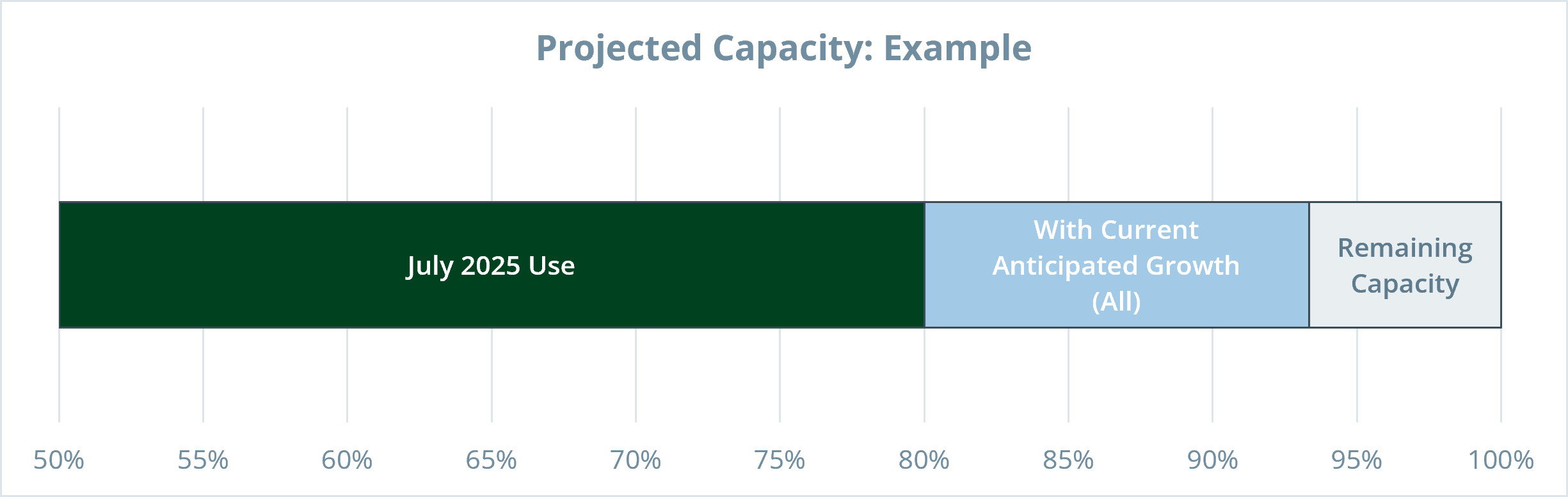
This illustrative graphic shows how the City evaluates current demand, anticipated growth, and remaining treatment capacity. Exact customer-specific usage projections may be limited by state law, but the City uses system-level planning to evaluate capacity and reliability.
Cedar Rapids draws drinking water from sand and gravel wells along the Cedar River, forming an alluvial aquifer system. This is different from many neighboring communities, which rely on Silurian or Jordan aquifers. Cedar Rapids’ alluvial aquifer system is connected to the Cedar River and allows the City to meet local demand while limiting impacts on neighboring communities’ groundwater supplies.
| City | Aquifer(s) | Notes |
| Cedar Rapids | Alluvial aquifer of the Cedar River | Horizontal and vertical collector wells constructed in sand and gravel deposits along the Cedar River. |
| Ely | Silurian | Aquifer is susceptible to contamination. |
| Fairfax | Silurian | Three wells tapping the Silurian aquifer; aquifer is susceptible to contamination. |
| Hiawatha | Silurian | Five wells tapping the Silurian aquifer; aquifer is susceptible to contamination. |
| Marion | Jordan, Silurian | 67% from Jordan, 33% from Silurian; Jordan aquifer has low contamination risk. |
| Palo | Silurian | Two wells tapping the Silurian aquifer; aquifer is susceptible to contamination. |
| Robins | Alluvial aquifer of the Cedar River | The City of Cedar Rapids supplies Robins’ drinking water. |
Cedar Rapids benefits from natural riverbank sand filtration and a network of 51 wells, which gives the system flexibility to manage seasonal nitrate conditions and maintain safe drinking water. The City’s treatment process includes lime softening, chloramine disinfection, sand filtration, and ultraviolet treatment.
Because Cedar Rapids drinking water consistently meets and exceeds EPA standards, it is considered safe for public consumption. To achieve this, the Water Division continuously monitors for contaminants and publishes annual water quality reports.
» Learn more about how the City is addressing common contaminant concerns such as nitrates and lead.
Data Center Water Use
Data centers use water primarily for cooling. Actual demand depends heavily on the cooling technology used. Industrial-scale data centers may use different systems, including:
- Closed-loop cooling systems, which recirculate water and reduce overall consumption
- Evaporative cooling systems, which release water to the atmosphere and generally require larger volumes
- Water-free cooling systems
- Reclaimed or gray water systems
Newer facilities increasingly use closed-loop systems and efficiency technologies. Some industrial users may also use reclaimed or gray water, further reducing potable water demand.
While State Law limits the City’s ability to share specific water use projections, we can share that current planned data center projects are expected to use less water combined than the system’s current largest water user(s), and that projected use remains within current treatment capacity.
It is also important to understand that water withdrawn from the Cedar River is not necessarily “lost.” Most water withdrawn by the City is returned to the river after treatment at the Water Pollution Control Facility. Some water is consumed in industrial processes or lost to evaporation, but much of the water returns to the river system after use and treatment.
Upstream Water Availability & Future Impacts
Because upstream water use can affect Cedar Rapids, the City evaluates potential future impacts carefully and as part of a longstanding water-supply planning process.
Cedar Rapids has a long history of studying, monitoring, and managing its water system in partnership with technical experts — such as the U.S. Geological Survey — to better understand river conditions, aquifer recharge, drought resilience, well placement, and long-term supply.
That work did not begin with data center development. Cedar Rapids has relied on decades of data, monitoring, modeling, and capital planning to guide water-system decisions. Extensive studies by Cedar Rapids and the U.S. Geological Survey show stable water production, even during droughts. Ongoing monitoring confirms our system is resilient, redundant, and well understood. River flow patterns have been documented for more than a century. Data from past droughts help guide decisions about well placement and system reliability.
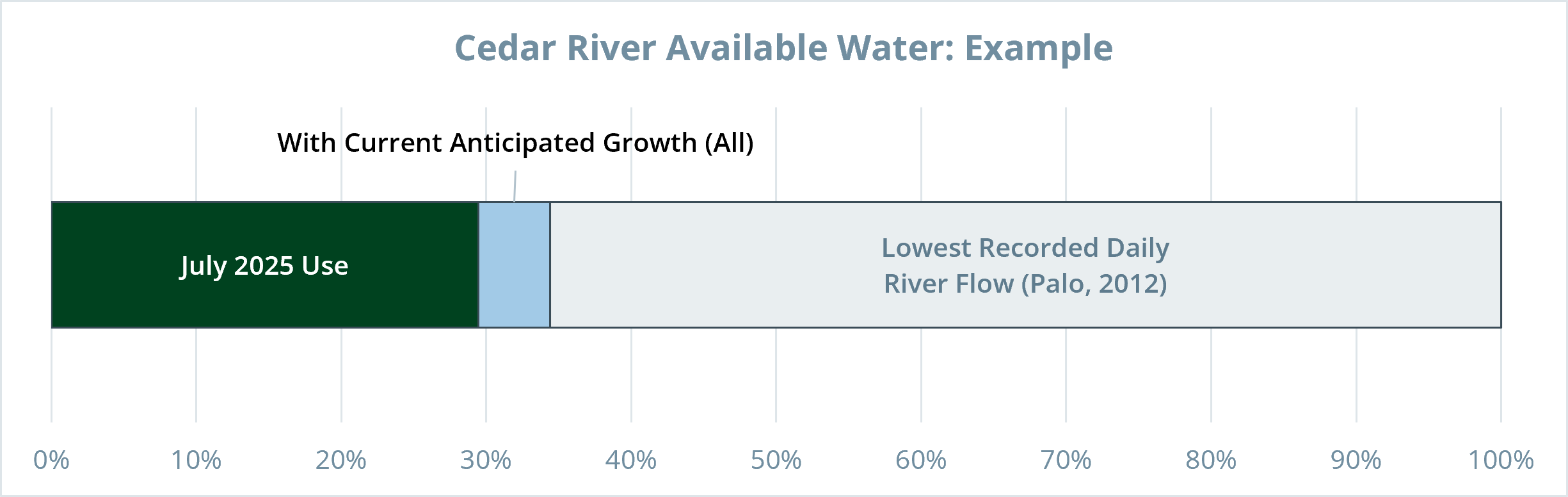
This illustrative comparison places Cedar Rapids water use and anticipated growth in context with historic low-flow conditions on the Cedar River. The City uses drought history, river-flow data, aquifer modeling, and long-term monitoring to evaluate source-water reliability.
As part of the City’s broader planning approach, we hired Black & Veatch to complete an independent Upstream Diversion Impact Study. The purpose of this work is to help the City better understand long-term risks to Cedar Rapids’ water supply from future regional growth, including possible large upstream water users and the potential restart of the Duane Arnold Energy Center.
This technical work is still in draft form. While the final public record will be shared at a future date when available, the City is able to share key preliminary findings from the ongoing analysis:
Based on current draft findings, Cedar Rapids’ water system remains well positioned. Black & Veatch evaluated a conceptual scenario involving an assumed 30 million gallons per day of production at a future wellfield upstream of Palo along the western side of the Cedar River. The preliminary analysis indicates that this hypothetical upstream wellfield would cause little, if any, drawdown of groundwater levels at the City’s wellfields. This is largely because of the approximate six-mile distance between the wellfields and the Cedar River providing a significant source of recharge between them.
The preliminary analysis also indicates that a 30 million gallon per day reduction in river flow from future upstream consumptive use would cause river levels past the City’s wellfield to decline by an average of approximately 0.05 foot during a period of low river flow. That would correspond to a reduction in aquifer yield to the City’s wellfields of less than 0.2 percent during very low river flow conditions. This reduction is considered minimal within the scope of the conceptual evaluation.
Draft water-quality modeling also indicates only minor changes compared with existing conditions. Across the water-quality constituents evaluated, maximum changes were generally small, with most parameters showing differences of 0 to -5 percent. Dissolved oxygen decreased by approximately 1.1 percent under the maximum withdrawal scenario and remained within a range consistent with baseline modeled conditions.
Overall, the current draft findings indicate that the evaluated future upstream water-use scenarios, including a potential large water user and Duane Arnold Energy Center withdrawals, are not expected to result in meaningful degradation of Cedar River water capacity or quality under the critical conditions reviewed.
Because this is a conceptual assessment, the findings would need to be refined if a future upstream wellfield project moves forward and as more field data are collected at the selected site. The City will continue to evaluate source-water needs, future regional growth, and potential upstream impacts as part of long-term water-supply planning.
Long-Term Planning
As the community grows, the City must continue evaluating treatment capacity, source water, wells, storage, distribution mains, wastewater treatment capacity, redundancy, resilience, regulatory requirements, and long-term system reliability.
This planning is not limited to any single project. The City was evaluating future water and wastewater needs before current data center projects were announced, and those planning efforts continue.
Future investments may include:
- Water treatment capacity improvements
- Additional or relocated wells
- Source water planning
- Storage improvements
- Distribution system upgrades
- Wastewater treatment and capacity improvements
- Redundancy and emergency reliability projects
- Regulatory compliance improvements
- Potential reuse, reclaimed water, or gray water opportunities
- Technology improvements to monitor and manage system demand
Large industrial projects may create opportunities to accelerate infrastructure improvements that benefit the broader community.
Ratepayer Protection
The City is not forecasting utility rate impacts associated with the data center projects. Utility rates may still have base annual adjustments unrelated to any individual project.
Cedar Rapids benefits from large industrial water users because their demand supports economies of scale. Those economies of scale can help keep residential rates more cost-effective while supporting local economic growth.
If Cedar Rapids were asked to serve a project requiring major treatment or distribution upgrades, those improvements would need to be funded responsibly.
Energy
Data centers require significant energy infrastructure. The City works with energy providers and development partners to understand how large projects fit within the broader energy system, economic development goals, and infrastructure planning.
Energy planning for current and future large-scale projects may involve coordination among private companies, energy providers, state partners, regional utilities, and the City, depending on the project and the infrastructure required.
Alliant Energy is the electric utility for Cedar Rapids’ data center projects. Learn more from their website, including answers to questions like:
- Will large energy users increase my energy rates?
- Can the local power grid handle this increase in energy demand?
- Will this increase in energy demand impact the environment?
Evaluating Future Projects
Cedar Rapids may receive future inquiries from data center companies or other potential large industrial users. Nearby communities may also receive inquiries. Some future projects may request City services, utility connections, infrastructure support, or development agreements. Others may proceed independently or outside Cedar Rapids.
The City evaluates potential future projects case by case. The City may consider involvement when a project:
- Falls within Cedar Rapids’ legal authority or service area
- Aligns with adopted economic development goals
- Can be served without compromising reliability
- Protects existing residents and industries
- Does not shift inappropriate costs to ratepayers
- Provides clear public benefit
- Meets applicable land use, utility, environmental, and permitting requirements
- Includes appropriate infrastructure commitments
- Supports long-term community and regional planning goals
The City may choose not to support or participate in a project if:
- The project would compromise water, wastewater, transportation, or utility reliability
- The project would shift costs unfairly to existing ratepayers
- The project does not provide sufficient public benefit
- The project does not meet applicable legal, land use, utility, or environmental requirements
- The City does not have authority or appropriate jurisdiction
- The long-term impacts are not sufficiently understood
- Required infrastructure cannot be responsibly planned, funded, or delivered
No future project should be assumed to have City support simply because the City has supported other projects. Each project must stand on its own facts.
Community members have asked about potential data center development in the Palo area and whether Cedar Rapids could be involved in providing water and wastewater services to regional projects. The City is aware of this development interest and has spoken with regional partners and developers to understand potential needs. Any future regional service request would need to be evaluated through appropriate technical, legal, financial, and policy review.
If a project involving utility service were to advance to the point of requiring formal City action — such as consideration of an agreement, amendment, or other City Council action — those proceedings would occur in public meetings in accordance with Iowa’s Open Meetings and Public Records laws, and associated materials would be part of the public record at that time.
What the City Is (and Is Not) Committed To
Because data center development is a fast-moving topic, it is important to be clear about what the City has and has not committed to.
What the City Has Done
- Approved development agreements for current projects: Google and QTS.
- Shared public information about those projects, including project details, agreement terms, community benefit commitments, water and wastewater planning information, and FAQs.
- Studied (and continues to study) water supply, treatment capacity, future well locations, drought scenarios, and potential impacts of large-scale future growth.
- Spoken with regional partners and developers to better understand potential water needs and regional development interest.
- Committed to protecting long-term water reliability, utility system reliability, residents, existing industries, and ratepayers.
What the City Has Not Done
- The City has not made an open-ended commitment to serve every future data center or industrial project.
- The City has not committed to support projects that would compromise reliability or shift inappropriate costs to existing ratepayers.
- The City has not committed to ignore future capacity needs. Continued growth will require continued infrastructure planning and investment.
- The City has not committed to treating every future project the same. Future projects will be evaluated based on their own facts, impacts, benefits, costs, technology, location, and infrastructure needs.
- The City has not committed to making decisions based on national headlines or assumptions from other communities. Cedar Rapids evaluates projects based on local data, local infrastructure, engineering analysis, and local public benefit.
Other Frequently Asked Questions
Are data centers already approved in Cedar Rapids?
The City has approved development agreements related to the Google and QTS projects. Each agreement includes specific terms, timelines, requirements, and conditions.
A separate data center at 1515 33rd Avenue SW is proceeding through the standard development review and permitting process because the use is allowed under the property’s existing industrial zoning. It did not require a development agreement, financial incentive, rezoning, public hearing, or City Council vote.
All data center projects must comply with applicable permitting, building, zoning, utility, fire, stormwater, and other regulatory requirements.
Are more data centers coming?
Communities that attract hyperscale data centers often see other data center projects follow. The City may receive future inquiries from data center companies or other large industrial users, and nearby communities may also receive inquiries. No future project should be assumed approved or supported simply because other projects have moved forward. Each project would need to be evaluated based on its zoning/permitted use, whether it is seeking a development agreement, infrastructure needs, water and wastewater demand, legal requirements, and other impacts.
Would the City support another data center?
The City would evaluate any future project case by case. With any economic development incentives, the City Council may choose to support projects that provide clear public benefit, can be served responsibly, protect residents and existing industries, and do not compromise utility reliability or shift inappropriate costs to ratepayers. The Council may choose not to support projects that do not meet those standards. When a proposed data center complies with existing zoning, it may proceed through standard development review and permitting without separate City Council approval. Staff review applicable zoning and site standards, building and fire codes, stormwater management, engineering and utility coordination, street access, landscaping, screening, and other applicable requirements. State, county, or federal regulations may also apply depending on the facility’s equipment and operations.
Why is Cedar Rapids allowing data centers?
Data centers are allowed in certain industrial zoning districts. When a proposed data center complies with existing zoning, it may proceed through standard development review and permitting without separate City Council approval. Projects requesting incentives, land-use changes, infrastructure agreements, or other discretionary City action require the corresponding additional review and approval.
Cedar Rapids is prepared to serve responsible growth when projects can be supported by available infrastructure, sound planning, legal authority, public benefit, and long-term community value. Data centers are one form of major investment evaluated through that lens.
Data centers are part of the infrastructure that supports modern life, including business operations, education, health care, public safety, national security, cloud services, artificial intelligence, communications, and everyday technology. Like other large-scale industrial projects, they require careful review of land use, utilities, water, wastewater, energy, transportation, emergency services, environmental considerations, public incentives, and long-term fiscal impact.
The community benefits are multifaceted. Projects can increase taxable value, generate new revenue, support infrastructure improvements, create construction and permanent jobs, diversify the local economy, strengthen Cedar Rapids’ position in the future economy, and help build capacity for future community and industrial needs.
At the same time, Cedar Rapids does not assume every project should move forward. Each project must be evaluated on its own facts, including infrastructure capacity, water resources, utility reliability, ratepayer protection, public benefit, environmental stewardship, and alignment with the City’s long-term goals.
The City’s goal is to welcome investment while making responsible decisions that protect residents, supporting businesses, public services, and the systems the community depends on every day.
Does Cedar Rapids have enough water?
Yes, current treatment capacity is sufficient for present and near-term planned growth, including approved data centers. Cedar Rapids has more than 60 million gallons per day of treatment capacity across the J Avenue and Northwest Treatment Plants. Continued growth will eventually require future investment, which is why the City plans ahead through its Capital Improvements Plan.
Is Cedar Rapids planning for future water needs beyond these projects?
Yes. The City plans for long-term community growth, not just individual projects. Planning includes treatment capacity, source water, wells, storage, pipes, redundancy, wastewater capacity, regulatory requirements, and system reliability. Future growth will require continued investment, and the City is evaluating how those investments should be timed, funded, and delivered.
Could future projects require new infrastructure?
Yes. Continued residential, commercial, and industrial growth may require future infrastructure improvements. Depending on the project, that could include water treatment, wells, storage, distribution mains, wastewater capacity, roads, electric infrastructure, or other improvements. The City evaluates those needs before making commitments.
Who pays for infrastructure needed by future projects?
Cost responsibility depends on the project, the type of infrastructure, legal requirements, and the public benefit. The City’s position is that growth-related infrastructure costs should be allocated responsibly and should not be shifted unfairly to existing ratepayers.
At the same time, Cedar Rapids must continue making ongoing investments in its water, wastewater, utility, transportation, and public infrastructure systems to keep them reliable, resilient, and ready for future needs. These investments are necessary to maintain existing service, replace aging assets, meet regulatory requirements, support emergency reliability, and prepare for long-term community and economic growth.
The City uses long-range planning, capital improvement programming, utility rate modeling, engineering analysis, and development agreements to determine how infrastructure should be funded. Depending on the circumstances, costs may be paid through a combination of developer contributions, connection or service fees, utility revenues, grants, bonds, tax increment financing, or other legally available funding sources.
For utility systems, targeted annual rate increases help provide the revenue needed to maintain reliability, replace aging infrastructure, meet operating costs, support capital improvements, and plan for future growth. These rate adjustments are not simply tied to one project; they are part of responsible long-term system management.
Is Cedar Rapids’ drinking water safe?
Cedar Rapids drinking water consistently meets EPA standards. The City continuously monitors water quality, benefits from natural river filtration, and uses a network of 51 wells to provide flexibility and reliability.
Is Cedar Rapids like places in national headlines with data center concerns?
The City is applying decades of industrial, utility, water, and infrastructure experience to evaluate whether projects can be served responsibly, how costs should be allocated, what public benefits are created, and how long-term community interests are protected.
Many national stories about data centers involve different source water conditions, utility systems, growth patterns, infrastructure constraints, state laws, regulatory environments, and development pressures than Cedar Rapids.
Cedar Rapids evaluates data center projects based on local facts, not national assumptions. That includes local engineering, local water data, local utility capacity, local infrastructure conditions, Iowa law, state and federal regulatory requirements, and the City’s long-term planning work.
Cedar Rapids also has a long history of serving major industrial users. For generations, the community has supported large-scale food production, agricultural processing, advanced manufacturing, logistics, aerospace, defense, and technology operations. This experience sets Cedar Rapids apart.
The City understands that major users require careful evaluation, responsible infrastructure planning, clear cost allocation, regulatory compliance, and thoughtful integration into systems that must continue serving residents, existing businesses, public services, and future community needs.
What is the Black & Veatch Upstream Diversion Impact Study?
The City hired Black & Veatch to complete an independent Upstream Diversion Impact Study as part of broader water-supply planning. The purpose of the work is to help Cedar Rapids better understand potential long-term risks to the City’s water supply from future regional growth, including possible large upstream water users and the potential restart of the Duane Arnold Energy Center.
The technical work is currently in draft form. The final public record will be shared at a future date when available. In the meantime, the City is able to share key preliminary findings.
What do the Black & Veatch Upstream Diversion Impact Study preliminary findings show?
The current draft findings indicate that Cedar Rapids’ water system remains well positioned. In a conceptual scenario involving an assumed 30 million gallons per day of production at a future wellfield upstream of Palo, the preliminary analysis indicates little, if any, drawdown at Cedar Rapids’ wellfields.
This is largely due to the approximate six-mile distance between the potential upstream wellfield and the City’s wellfields, as well as recharge provided by the Cedar River.
Would upstream water use significantly reduce Cedar Rapids’ water supply?
Based on the current draft findings, a 30 million gallon per day reduction in river flow from future upstream consumptive use would cause river levels past the City’s wellfield to decline by an average of approximately 0.05 foot during a period of low river flow.
That would correspond to a reduction in aquifer yield to the City’s wellfields of less than 0.2 percent during very low river flow conditions. This reduction is considered minimal within the scope of the conceptual evaluation.
Why did Cedar Rapids study upstream water use?
The City studied upstream water use because future regional growth, including possible large upstream water users and the potential restart of the Duane Arnold Energy Center, could affect the Cedar River system.
Studying those possibilities early helps Cedar Rapids understand long-term source-water needs, evaluate potential impacts independently, make informed infrastructure decisions, and plan responsibly for residents, industry, and future generations.
Will these projects increase residential utility rates?
The City is not forecasting utility rate impacts associated with the current data center projects. Utility rates may still have base annual adjustments unrelated to any individual project. If a project requires major treatment or distribution upgrades, the City’s position is that those upgrades should be funded responsibly and should not shift costs unfairly to existing ratepayers.
What is the Community Betterment Fund?
The Google and QTS development agreements include Community Betterment Fund payments for broader public benefit. The funds can support amenities, infrastructure, economic development, workforce, quality-of-life projects, and other community needs. City Council determines how the funds are used.
Do companies control the Community Betterment Fund?
No. Companies may provide input, but they do not control the funds. The City Council determines how Community Betterment Fund dollars are used.
Are incentives reducing taxes for schools, police, fire, or public services?
Existing taxes on the original property value continue to be paid. Incentives are tied to new value created by the project. Depending on the agreement, a portion of the new tax value may be rebated or exempted for a defined period, while the remaining portion is paid and supports public services.
Recent changes to Iowa’s Tax Increment Financing law will also limit the diversion of school foundation property tax revenues through future TIF agreements. In general, the school foundation levy will no longer be included in future TIF increment unless a school district chooses to opt in. This means those revenues would generally continue supporting schools rather than being redirected through TIF.
How many jobs will be created?
The following employment estimates relate to the Google and QTS campus projects. These projects are expected to support hundreds of permanent direct onsite jobs over time, based on anticipated end-user needs and full project buildout. Exact figures on data center job creation vary widely and depend on data center type and end-user business model.
While the development agreements establish minimum job requirements that must be met to qualify for incentives, those minimums are not intended to represent the full long-term employment potential of the projects.
Under approved agreements, the Google project is required to create at least 31 new full-time jobs at or above the State’s High-Quality Wage Rate. The QTS project is required to create at least 15 jobs per phase, or an estimated 30 jobs for the initial and next project phases. Those requirements provide enforceable minimums, while the actual number of permanent onsite jobs is expected to grow as the campuses develop, end users are added, and operations expand over time.
Construction activity is also expected to support hundreds of construction and trade jobs, with broader economic impact in the regional economy. Economic analysis indicates each new data center job would support an additional 1.99 jobs in the broader Cedar Rapids metro economy.
Conservative estimates project approximately 3,000 new construction jobs in Cedar Rapids through 2030 associated with the Google and QTS projects. The economic benefit of construction employment is estimated at $423 million per year in new wages. During the construction phase, each dollar paid to temporary construction workers is estimated to generate an additional $0.47 in the metro economy. Construction activity also has the potential to support up to 5,000 additional jobs through supply-chain activity and increased household spending.
Are data centers worth it if they do not create as many jobs as some other industries?
Data centers are capital-intensive projects. Their benefits include construction jobs, permanent high-quality jobs, large-scale tax base growth, infrastructure investment, utility revenue, community betterment payments, and secondary economic activity. They are evaluated not only by permanent on-site job count, but also by total investment, tax value, infrastructure contribution, and broader economic impact. The economic value-add that results from data center development makes a significant contribution to growing the total economic output (Gross Domestic Product) of the Greater Cedar Rapids region.
U.S. Bureau of Labor Statistics data show computer science and related occupations typically pay above the Cedar Rapids median household income, currently estimated at $79,180 (Moody’s Analytics, CY26 Q1).
Why are these projects considered beneficial if they receive incentives?
Incentives are tied to new value created by the projects and are performance-based, not guaranteed. Existing property tax revenues are retained, and the City and other local taxing bodies continue to receive a portion of new property tax revenue during the incentive period. The projects also create major construction activity, permanent jobs, community betterment payments, utility and infrastructure investment, and long-term taxable value that remains in the community after the incentive period.
What happens if a company does not meet the terms of its agreement?
Development agreements include conditions, timelines, and requirements. If a company does not meet applicable terms, incentives may not be earned or may be affected according to the agreement.
What is the difference between Google, Heaviside, and QTS?
Google and QTS are separate data center projects associated with Cedar Rapids.
Google is the company associated with a proposed data center campus in the Big Cedar Industrial Center area, along Edgewood Road SW and 76th Avenue SW. The project was originally advanced through development agreement terms authorized by the Cedar Rapids City Council in February 2024 in connection with Heaviside, LLC.
Some early public documents refer to Heaviside, LLC because that was the project entity associated with the development agreement terms considered by City Council before Google was publicly announced as the company behind the potential project. This is a common structure in large economic development projects, where a project entity may be used during site evaluation, due diligence, land planning, incentive review, or early agreement discussions before the end user is publicly identified.
References to Heaviside and Google in City materials relate to the same data center project associated with the Big Cedar Industrial Center area along Edgewood Road SW and 76th Avenue SW.
QTS is a separate data center project. QTS Cedar Rapids LLC has a development agreement with the City for a data center campus on approximately 612 acres in the Big Cedar Industrial Center. The QTS project has its own development agreement, project terms, timeline, incentive structure, and Community Betterment Fund commitment.
What is a closed-loop cooling system?
A closed-loop cooling system continually recirculates water, eliminating the need for a continuous supply of fresh water for cooling once operational. QTS has shared that its Cedar Rapids data center campus will use air-cooled chillers to achieve this approach, which is intended to reduce impacts on water resources. QTS also states that, once operational, the Cedar Rapids campus is expected to save approximately 4 billion gallons of water annually compared to similar-sized data centers that use evaporative cooling.
Is Palo part of the Cedar Rapids project?
The City’s approved data center development agreements relate to the Google and QTS projects in the Big Cedar Industrial Center area, not discussions about Palo. The separate project at 1515 33rd Avenue SW is also located within Cedar Rapids but does not involve a City development agreement.
Will Cedar Rapids support unlimited growth?
Cedar Rapids supports responsible growth, but not growth that compromises reliability, shifts costs unfairly to existing ratepayers, or proceeds without understanding long-term impacts.